

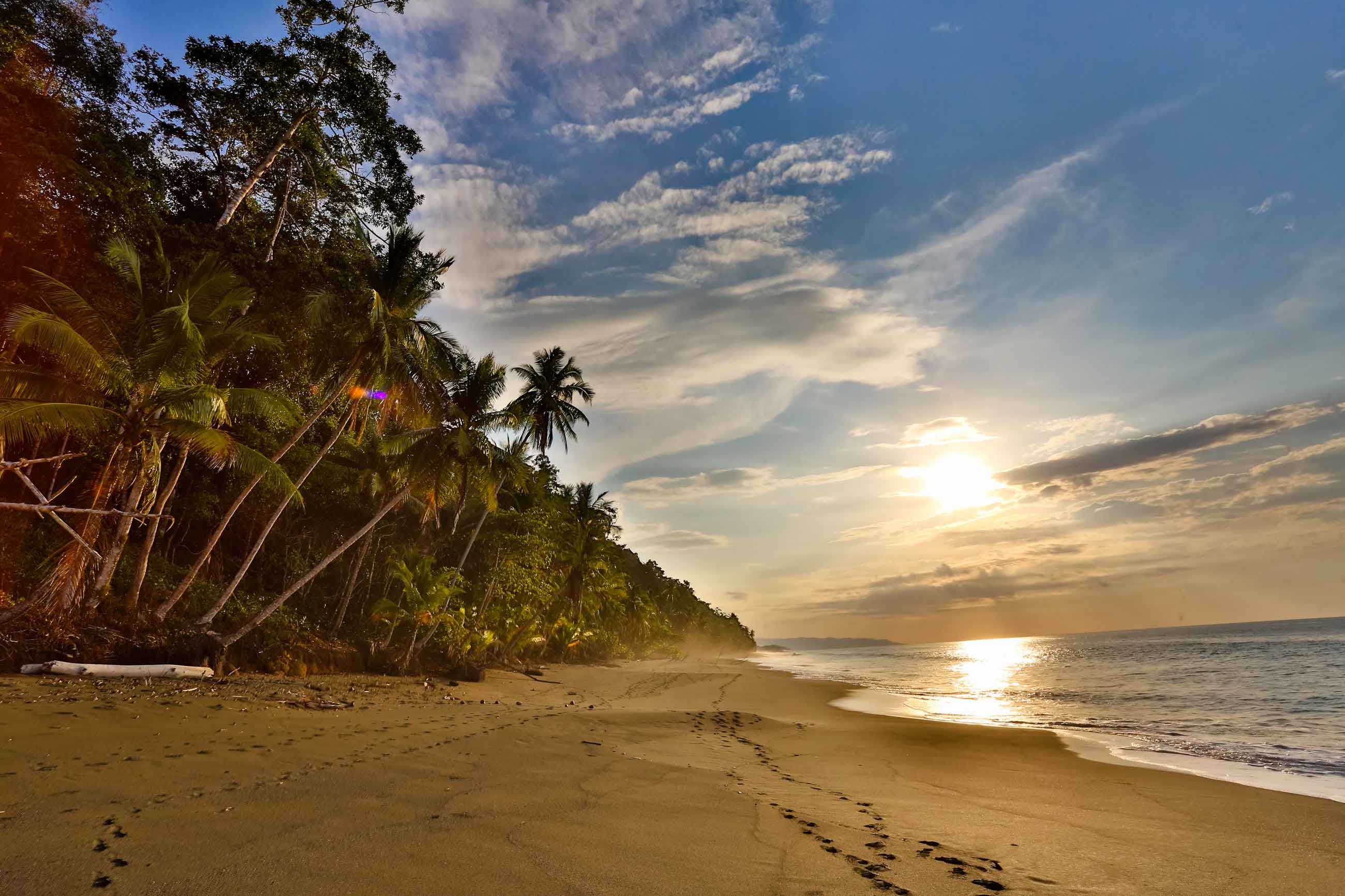
Marvelous beaches, active volcanoes, tropical jungles, great wildlife, untouched nature, beautiful weather and the unique “Pura Vida” (pure life) lifestyle: Costa Rica has it all.
Off the beaten track with amazing activities like zip lining from tree to tree at the rain forest, colorful birds and funny monkeys, walking on hanging bridges, surfing the waves of the warm waters of our Pacific coast, experiencing the taste of the local market and discovering our tropical fruits and our delicious coffee that is what makes Costa Rica a unique place on earth.
With about 25% of the country protected in national parks and reserves, hosting 5% of the world biodiversity and an average yearly temperature of 25°C (77° Fahrenheit) and sunshine nearly every day, Costa Rica is a fantastic destination any time of the year.
In short, a peaceful country, known as a leading ecotourism destination, offering unique activities wrapped up in beautiful sceneries, with great yearly weather, happy and joyful people, Costa Rica is the best destination for leisure and incentive travel.
Costa Rica Facts
Location:
Costa Rica is located approximately ten degrees north of the Equator on the isthmus of Central America. Costa Rica is bordered in the north by Nicaragua and in the south by Panama. To the east are the shores of the Caribbean Sea and to the west the Pacific Ocean.
Costa Rica is located approximately ten degrees north of the Equator on the isthmus of Central America. Costa Rica is bordered in the north by Nicaragua and in the south by Panama. To the east are the shores of the Caribbean Sea and to the west the Pacific Ocean.
Capital city:
San Jose
Size:
Costa Rica is a small country of 51 000 square kilometer or less than 20,000 square miles in size. At its narrowest point just 75 miles (120 Km) separate the Caribbean Sea from the Pacific Ocean. From north to south the country is just 180 miles (290 Km) long.
Climate:
The climate in Costa Rica varies depending upon elevation and location. The coastal plains are hot (not too hot) and tropical. Mountainous regions are much cooler and the Central Plateau has a spring- like climate year round, with little variation in temperature from month to month. (The average daily temperature is 75° F or 25° C). Lots of sunny days.
Population:
Costa Rica currently has a population ca. 4.5 million inhabitants, predominantly of European (Spanish) origin. Indigenous peoples account for less that 2% of the total population.
Language:
The official language is Spanish, although English is widely spoken.
Religion:
Roman Catholicism is the official religion of Costa Rica and over 80% of the population is Roman Catholic.
Turtle nesting season in Costa Rica:
The most popular destinations to observe the turtle nesting are Tortuguero (North Caribean Coast) and Playa Grande (Pacific Coast). The nesting seasons are different for each species.
The nesting season of the leatherback turtle, the world’s largest sea turtle at six feet long and up to 1,500 pounds, can be seen at the North pacific Coast, Playa Grande just north of Tamarindo Beach from October to March.
The green sea turtle, Tortuguero’s jewel, with a weigh up to 400 pounds can lay up to 700 eggs per season and can be seen from July to September
Whale watching season:
Costa Rica’s waters offer the necessary temperature, health conditions and location, so different species of whales come year round to mate, give birth and raise their young before heading back to colder waters.
The most important location for humpback whale sightings is located at the south pacific coast of Costa Rica, more specific, Marino Ballena National Park, located south of Dominical Beach and Drake Bay at Osa Peninsula.
The best time of the year is from December to April and August to December.
Currency:
The colon is the national currency. Dollars can be exchanged at most banks.
Traveler checks in dollars can usually be changed at any bank and at most hotels, with a valid passport.
Entry Requirements:
Everyone needs a passport valid for a least three months. Some nationalities need a visa to enter (see www.rree.go.cr)
International airports: 2
International airport Juan Santamaria in San Jose
International airport Daniel Oduber in Liberia
International flight times:
Miami – Costa Rica 2 hours
Los Angeles – Costa Rica 6 hours
New York – Costa Rica 4 hours
Frankfurt – Costa Rica 13 hours
Mexico – Costa Rica: 3 hours
Panama – Costa Rica: 1 hour
Electricity:
Service is the same as in the United States: 110 Volts, 60 cycles. European electrical items need and adapter.
Weights & measure:
Metric
Credit Cards:
Major international credit cards (Masters / Visa / Amex) are accepted in most larger hotels, stores, restaurants. But at a smaller and more remote stores, one should be prepared to pay in local currency.
Time:
Costa Rica is two hours earlier the United State’s Eastern Standard Time (in winter one hour) and eight hours earlier of Central European Time (in winter seven hours).
Drinking water:
The water is generally considered very safe in San Jose and most larger cities and modern resorts. However, precautions should be taken in more remote locations.